Glossary

409A Valuation
409A valuations provide fast-growing private companies with an independent and defensible fair market value for common stock, helping ensure IRS compliance, avoid tax penalties, set fair option strike prices, and build confidence among new hires and investors.

Double Blind Intro
Blind introductions allow investment parties to connect confidentially without revealing identities until mutual interest is confirmed, protecting sensitive relationships, reducing reputational risk, and enabling open strategic discussions through intermediaries who share anonymized information.

Private Market Data
Private market data provides critical pricing, valuation, and performance intelligence that helps investors benchmark returns, conduct diligence, improve decision-making, and manage risk by integrating analytics and market feeds into ongoing portfolio evaluation and optimization.
.jpg)
Duration Risk
Duration risk reflects the sensitivity of long-term fixed-income investments to interest rate changes, as rising rates can erode asset values and income, making active management, liability matching, and hedging strategies like swaps critical for private credit funds and other long-duration investors.
Downside Risk
Downside risk measures the potential loss in an adverse scenario, helping investors protect capital, construct resilient portfolios, and meet fiduciary and risk management standards through scenario modeling, stress testing, and sensitivity analysis when evaluating private investments.

Deal on Desk
An “on desk” deal represents a live investment opportunity actively under review, giving investors early access that can support stronger terms, enhance competitive positioning, and improve deal flow management as teams conduct screening, due diligence, and internal evaluation before progressing.
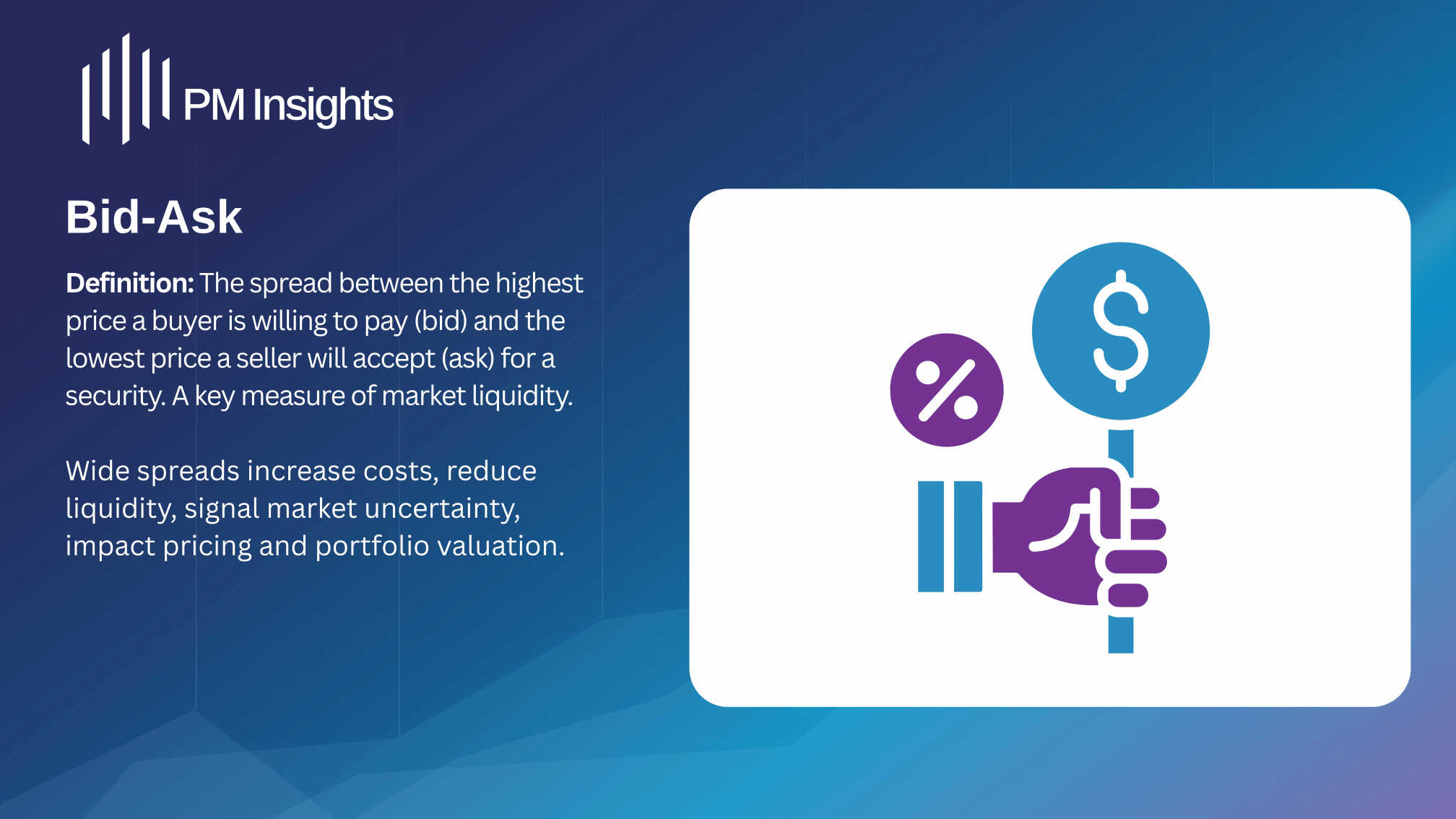
Bid-Ask
The bid-ask spread reflects the difference between the highest price a buyer will pay and the lowest price a seller will accept, serving as a key indicator of liquidity; wide spreads increase trading costs, signal limited market depth or uncertainty, and affect pricing decisions, valuation, and portfolio returns in private secondary transactions.

Best Execution
Best execution requires asset managers to seek the most favorable trading terms reasonably available across price, speed, and execution quality, helping reduce transaction costs, preserve returns, meet fiduciary and regulatory obligations, and maintain client trust through smart routing, algorithmic trading, and post-trade analysis.
No results found for this filter, please select another type

PM Insights regularly publishes research that reveals market trends across 50+ sub-sectors including SaaS, FinTech, Entertainment, Data, & more.
Subscribe to our newsletterReady to see it in action?
Schedule a demo with one of our experts